Online Consultation
Vaginal Delivery in Gurgaon

Everything You Need to KnowAbout Vaginal Delivery

Vaginal delivery is the most common way for a baby to be born. It’s a natural process that can be empowering for many women. However, it can also be challenging, especially for first-time mothers.

Kalosa Obs & Gynae Clinic is a leading medical facility in Gurgaon that specializes in obstetrics and gynecology. Here’s everything you need to know about vaginal delivery in Gurgaon.

Book Your Consultation
Best obstetrician in Gurugram - vaginal delivery care by Dr Deepti Asthana

Benefits of vaginal delivery

Where there is no medical reason to do otherwise, a vaginal birth is usually the safest route for both mother and baby, and the one that allows the quickest return to normal life.

Vaginal delivery can reduce the risk of respiratory problems for the baby.

It can also help the baby acquire good bacteria from the mother, which boosts their immune system.

Vaginal delivery can help the mother recover faster than a C-section.

It can also be a more cost-effective option than a C-section.

Pregnancy care and delivery at Kalosa Clinic, Gurgaon

Vaginal delivery and caesarean section compared

Both are safe, and one is not universally better than the other — what matters is which is right for your pregnancy. This is how the two usually differ when there is a genuine choice between them.

  Vaginal delivery Caesarean section
Hospital stay Usually 24 to 48 hours Typically 3 to 4 days
Recovery at home Most women are comfortable within 1 to 2 weeks Around 4 to 6 weeks before normal activity
Scar No abdominal scar A scar low on the abdomen
Baby’s breathing Lower risk of respiratory problems Slightly higher risk of transient breathing difficulty
Future pregnancies No restriction on spacing Spacing of at least 18 months is generally advised
Cost More cost-effective Higher, because of theatre time and longer stay

From preparation to the first hour
what happens, and when

01

Preparing for vaginal delivery

  • Attend prenatal classes to learn about labor, delivery, and postpartum care
  • Prepare a birth plan with your doctor and discuss your preferences for pain relief, monitoring, and other aspects of delivery
  • Pack a hospital bag with essentials such as clothes, toiletries, and baby supplies
  • Have a support system in place, such as a partner or a doula, to help you during labor and delivery
02

Signs of labor

  • Contractions that become longer, stronger, and closer together
  • A “bloody show,” which is a discharge of mucus tinged with blood
  • Water breaking, which is the rupture of the amniotic sac
  • Back pain, cramps, and other discomforts

Contractions that are regular, around five minutes apart and lasting a minute each, are the point at which most women are asked to come in.

03

What to expect during vaginal delivery

  • Labor typically lasts for 12 to 24 hours, but it can be shorter or longer
  • Your doctor will monitor your progress and the baby’s well-being throughout the delivery
  • You may receive pain relief medication, such as an epidural if you choose to
  • You will need to push when you feel the urge and follow your doctor’s guidance
  • After the baby is born, the doctor will examine them and may place them on your chest for skin-to-skin contact
04

The first hours afterwards

  • The placenta is delivered within about half an hour of the birth
  • Any tear or episiotomy is repaired under local anaesthetic
  • Blood loss, pulse and blood pressure are watched closely for the first few hours
  • The first feed is usually offered within the first hour, while the baby is most alert

The stages of labour

Knowing what each stage involves makes the whole process far less frightening, particularly for a first baby.

Stage What it covers How long it usually takes
First stage From the onset of regular contractions until the cervix is fully open at 10 cm. The longest stage. In a first pregnancy it commonly runs 8 to 12 hours or more.
Second stage From full dilatation until the baby is born. Usually up to two hours in a first birth, and often much quicker in later ones.
Third stage Delivery of the placenta after the baby is born. Around 5 to 30 minutes. A medicine is given to help the uterus contract and limit bleeding.
Fourth stage The first two hours after delivery. Mother and baby are observed together. Feeding and skin-to-skin contact are started.

These timings are a guide rather than a rule. Every labour is different, and progress is judged by how the cervix is opening and how the baby is coping, not by the clock alone.

Pain relief options during labour

You do not have to decide everything in advance. Preferences are noted in the birth plan, and they can be changed at any point during labour.

Epidural analgesia

The most effective form of pain relief in labour. A fine catheter placed in the lower back gives continuous relief while you stay awake and alert. It does not increase the chance of a caesarean.

Breathing and positioning

Upright positions, walking in early labour, and controlled breathing all help. Many women manage the first stage entirely this way before deciding about an epidural.

Warm compresses and massage

Simple measures that ease backache during contractions, and are often the most useful thing a birth partner can do.

Injectable pain relief

An option in early labour when an epidural is not yet appropriate. Timing is chosen carefully so that it does not affect the baby’s breathing at birth.

Choosing the best vaginal delivery doctor in Gurgaon

  • Look for a doctor who has experience in vaginal deliveries and has a good reputation.
  • Consider the doctor’s availability, especially in case of an emergency.
  • Check the doctor’s qualifications and certifications.
  • Read online reviews and ask for referrals from friends and family.
  • Choose a doctor who makes you feel comfortable and addresses your concerns.
  • Check the doctor’s accessibility, and how close the hospital is to where you live.

One practical point that is often overlooked: ask who will actually attend your delivery. Labour does not keep office hours, and knowing that your own obstetrician will be there, rather than whoever is on duty, makes a real difference to how the night goes.

When a vaginal delivery may not be advised

Sometimes a caesarean is planned in advance, and sometimes the decision is made during labour. In either case it is made for a specific reason, and that reason is always explained to you.

  • The placenta is lying over the cervix, which blocks the way out for the baby.
  • The baby is lying transverse, or is breech and cannot be safely turned.
  • There is a previous classical uterine scar, or more than one previous caesarean.
  • The baby is showing signs of distress on monitoring during labour.
  • Labour is not progressing despite adequate contractions over several hours.

A change of plan during labour is not a failure. The aim throughout is a healthy mother and a healthy baby, by whichever route gets there most safely.

Obstetric care and delivery in Gurgaon
Postnatal care in Gurgaon

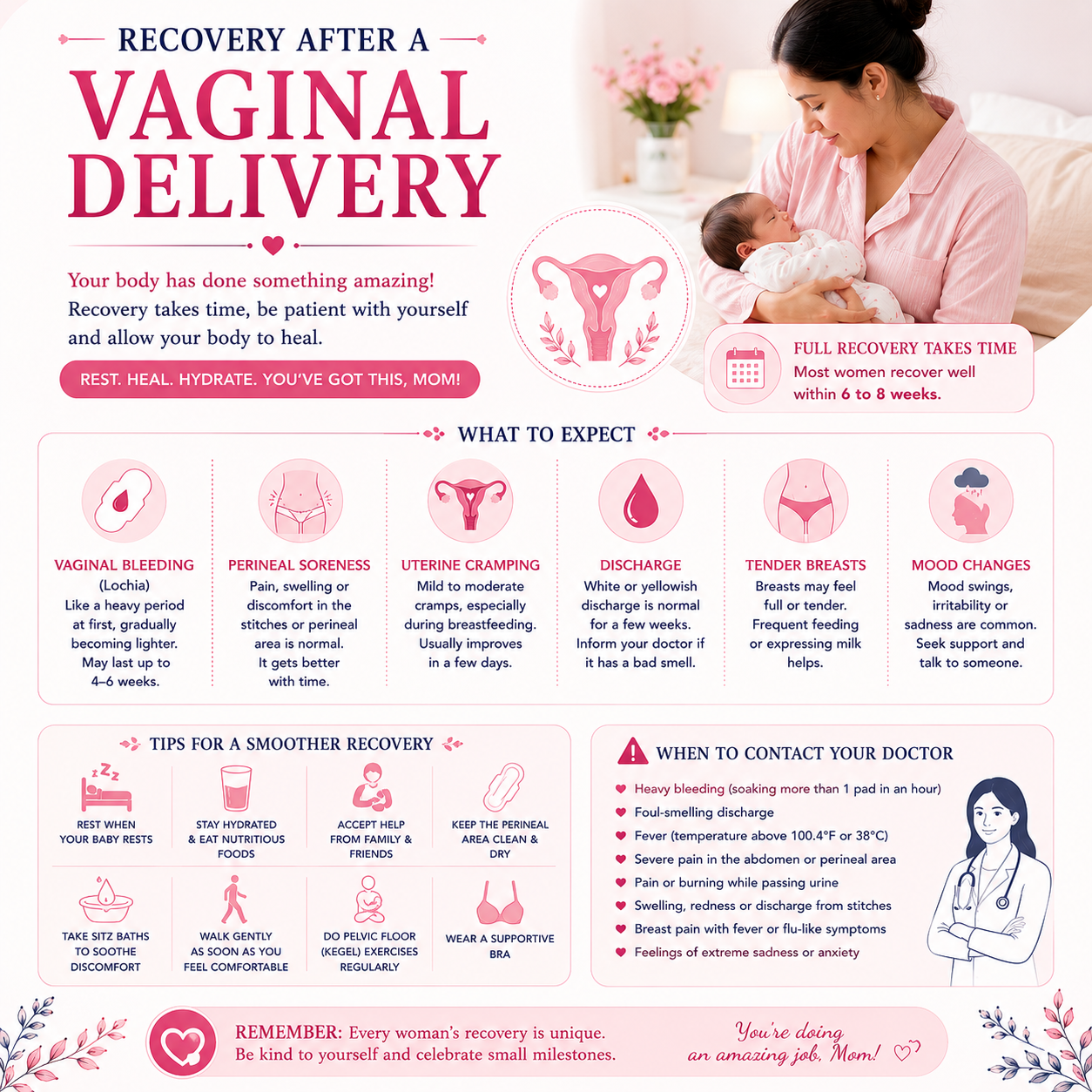
Recovery after a vaginal delivery

Recovery is quicker than after a caesarean, but it is still recovery. Rest matters as much as anything else in the first fortnight.

  • Walking is encouraged within a few hours, which helps circulation and recovery.
  • Bleeding gradually lessens over two to six weeks and changes from red to brown to pale.
  • Stitches from a tear or episiotomy dissolve on their own in two to three weeks.
  • Pelvic floor exercises are started once you are comfortable, and continued lifelong.
  • The postnatal check is at six weeks, and contraception is discussed at that visit.

Services at Kalosa Obs & Gynae Clinic

Kalosa Obs & Gynae Clinic provides a wide range of services for expectant mothers and newborns, including prenatal care, delivery, and postnatal care.

Prenatal Care

  • Comprehensive prenatal care to ensure a healthy pregnancy
  • Regular check-ups to monitor the health of the mother and the baby
  • Ultrasound scans to check the baby’s growth and development
  • Nutritional counseling to ensure proper diet and weight gain during pregnancy
  • Screening tests for genetic disorders, infections, and other complications

Delivery

  • A safe and comfortable environment for labor and delivery
  • Options for pain relief, such as epidural anesthesia
  • Close monitoring of the mother and the baby during labor
  • Assistance with natural childbirth, vaginal delivery, or C-section, depending on the mother’s preference and medical needs
  • Immediate care for the newborn, including resuscitation if needed

Postnatal Care

  • Regular check-ups for the mother and the baby after delivery
  • Breastfeeding support and counseling
  • Management of postpartum complications, such as infections or bleeding
  • Family planning services, including contraception counseling and birth spacing
  • Referral to other medical specialists, if needed

Specialized Care

  • High-risk pregnancy management for women with medical conditions or complications
  • Fetal medicine services, including fetal ultrasound, genetic counseling, and prenatal diagnosis
  • Neonatal intensive care unit (NICU) for premature or sick newborns
  • Pediatric care for newborns and infants
20+ Years of Experience
30,000+ Happy Patients
10,000 Surgeries
Dr Deepti Asthana  ·  Care  ·  Precision

Senior Obstetrician & Gynaecologist in Gurgaon

Additional Director, Obstetrics & Gynaecology, Fortis Memorial Research Institute — and Director, Kalosa Clinic.

    Dr. Deepti Asthana is a highly esteemed Obstetrician and Gynecologist with over 14 years of dedicated clinical experience. Holding an MBBS from KGMC, Lucknow, and an MS from SMS Medical College, Jaipur, she is currently a Consultant at Fortis Memorial Research Institute, Gurgaon, and the Director of Kalosa Aesthetics.

    A cornerstone of her comprehensive obstetric practice is her strong advocacy and exceptional expertise in facilitating a safe Vaginal Delivery. She believes that childbirth is a natural, empowering journey and strives to provide expectant mothers with the highest chances of a normal, physiological birth. Successfully navigating a Vaginal Delivery requires immense patience, clinical precision, and continuous fetal monitoring to ensure the absolute safety of both mother and baby. Dr. Asthana is highly skilled in managing active labor, safely addressing unexpected complications, and offering modern pain relief options.

  • Specialises in normal deliveries and high risk pregnancy
  • 30,000+ patients and 10,000+ surgeries

Meet Dr Deepti Asthana

Dr Deepti Asthana, gynaecologist in Gurgaon
Patient Testimonials

What patients are saying
about Dr Deepti Asthana

Recognising that patient care, a gentle bedside manner and precise clinical outcomes come first, Dr Deepti Asthana takes pride in being a compassionate doctor who always puts her patients’ needs first.

View All
SS
Shreya Saini
★★★★★

I am very satisfied and happy with the results of my treatment. She is an amazing doctor — very kind and humble. She made me understand what was the right choice for me even before the procedure, and I am glad I chose to trust her. The staff is also very polite and cooperative.

Oct 06, 2022 | Google
A
Akash Yadav
★★★★★

At first I was a little anxious, but after meeting the staff and Dr Asthana herself I felt reassured. After the procedure I was very satisfied with the outcome and the care I received throughout.

Sep 07, 2022 | Google
Watch Our Videos

Pregnancy and delivery, explained on video

Dr Deepti Asthana answers the questions expectant mothers ask most often in the clinic.

What Doctors Check BEFORE Pregnancy | Complete Guide

Dr. Deepti Asthana explain the most important pre-pregnancy health checks every woman and couple should know before trying to conceive. From PCOS, diabetes, obesity, and high blood pressure to smoking, alcohol, fertility, miscarriage risks, and family medical history — this is a complete pregnancy planning guide..

Successful Pregnancy के लिए सबसे जरुरी बातें! | Important Tips for Pregnancy | Dr. Deepti Asthana

Are you planning for pregnancy and wondering if you’re ready? In this video, discuss the 3 most important things every couple must check before conceiving. From mental and physical readiness, to family medical history, and the impact of smoking, alcohol and lifestyle habits, this video covers everything you need to know before planning a baby.

What Doctors Check BEFORE Pregnancy | Complete Guide

Dr. Deepti Asthana explain the most important pre-pregnancy health checks every woman and couple should know before trying to conceive. From PCOS, diabetes, obesity, and high blood pressure to smoking, alcohol, fertility, miscarriage risks, and family medical history — this is a complete pregnancy planning guide..

Quick Health Insights

From our Instagram

Short expert insights on pregnancy care, delivery and women’s health.

Frequently Asked Questions

Women under 17 or over 35 years of age are considered to have a high-risk pregnancy. Other reasons include a history of complicated pregnancies such as preterm labour, caesarean section, pregnancy loss or a child with birth defects, and a family history of genetic conditions.

An obstetrician and gynaecologist takes care of women during pregnancy and after childbirth, and delivers babies. An ob-gyn is trained to handle some of the most important health issues in a woman's life, including birth control, childbirth and menopause.

Labor typically lasts for 12 to 24 hours, but it can be shorter or longer. First-time mothers usually take longer than women who have delivered before, and the second and third stages are considerably quicker in later pregnancies.

Yes. An epidural is the most effective pain relief available in labour and is given by an anaesthetist. It does not increase the chance of needing a caesarean section, and it allows you to stay awake and alert throughout the birth.

Most mothers go home 24 to 48 hours after an uncomplicated vaginal delivery, once feeding is established and both mother and baby have been checked. Recovery at home is usually comfortable within one to two weeks.

Not always. If a tear occurs or an episiotomy is needed, it is repaired under local anaesthetic straight after the birth. The stitches dissolve on their own over two to three weeks and do not need to be removed.

Many women can. A vaginal birth after one previous lower segment caesarean is often possible, provided the scar is of the usual type, the baby is a normal size and labour starts on its own. The decision is made individually after reviewing your earlier operation notes.

Progress is assessed regularly during labour. If contractions are inadequate they can be strengthened with medication. If there is still no progress despite adequate contractions, or if the baby shows signs of distress, a caesarean section is advised for safety.

Come in when contractions are regular, roughly five minutes apart and lasting about a minute, or straight away if your water breaks, if you notice bleeding, or if the baby's movements reduce — regardless of how far apart the contractions are.

Look for a doctor who has experience in vaginal deliveries and a good reputation, check qualifications and certifications, consider availability in case of an emergency, and read online reviews or ask for referrals from friends and family. Above all, choose someone who makes you feel comfortable and addresses your concerns.

Quick Links