Online Consultation
Menopause & Vaginal Prolapse

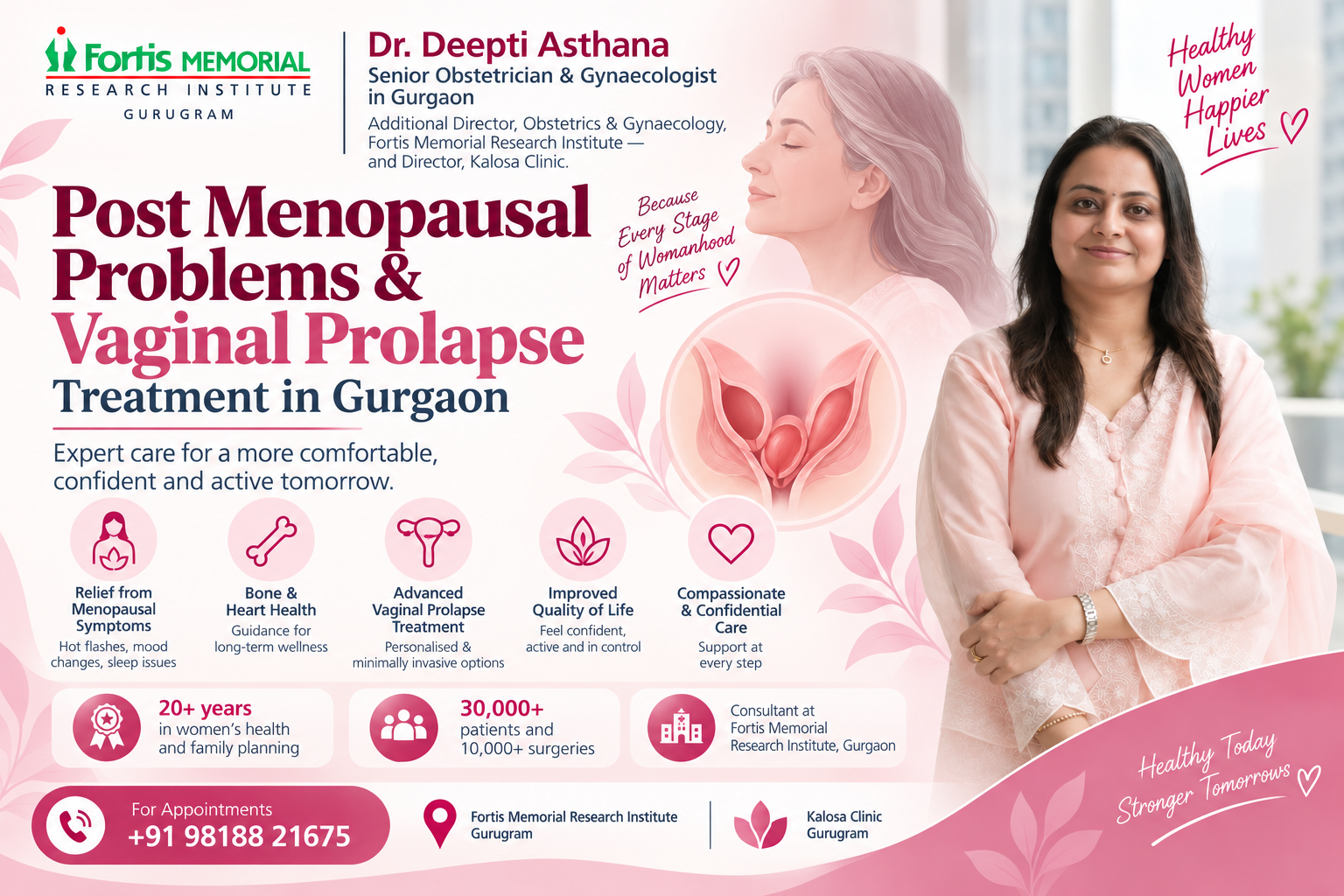
Post Menopausal Problems& Vaginal Prolapse Treatment in Gurgaon

Menopause is a natural part of a woman’s life cycle. It’s a time when your oestrogen and progesterone levels decrease. Following menopause, your risk for certain conditions like osteoporosis or cardiovascular disease may increase.

There are plenty of treatment options to help with post-menopausal symptoms. Contact us for menopause treatment in Gurgaon if you experience symptoms that affect your ability to function.

Book Your Consultation
Post menopausal and vaginal prolapse treatment in Gurgaon by Dr Deepti Asthana

How postmenopause affects the body

There is a wide variety of post-menopausal symptoms, and they can cause issues both emotionally and physically.

Menopause is a natural part of a woman's life cycle, when oestrogen and progesterone levels decrease.

Following menopause, the risk for certain conditions like osteoporosis or cardiovascular disease may increase.

Post-menopausal symptoms can affect both the body and the mind, and vary widely from woman to woman.

There are plenty of treatment options available if symptoms affect your ability to function day to day.

Menopause symptoms and treatment in Gurgaon

Emotional & psychological symptoms

  • Phobias.
  • Depression.
  • Anxiety.
  • Paranoia.
  • Mood swings.
  • Sleep issues and difficulty concentrating.

Physical symptoms

  • Hot flashes.
  • Vaginal dryness.
  • Lowered libido.
  • Urinary tract infections.
  • Stress incontinence.

You can visit Kalosa Gynae Clinic for the best post-menopausal treatment in Gurgaon.

Vaginal prolapse and its management

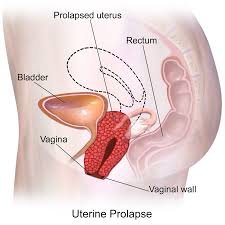
Vaginal prolapse is a condition in which structures such as the uterus, rectum, bladder, urethra, bowel, or the vagina itself may begin to prolapse, or fall out of their normal positions. This is most commonly due to pelvic muscle weakness following repeated vaginal deliveries.

Type What it is
Rectocele Prolapse of the rectum into the back wall of the vagina.
Cystocele Prolapse of the bladder, sometimes called a dropped bladder.
Urethrocele Prolapse of the urethra.
Cystourethrocele Combined prolapse of the bladder and urethra.
Enterocele Herniation of the small bowel into the vaginal wall.
Prolapsed Uterus The uterus descends from its normal position into or through the vagina.
Vaginal Vault Prolapse Prolapse of the top of the vagina, occurring after a hysterectomy.

If you’re in your late 40s or early 50s, and are closer to menopause, visit Kalosa Gynae Clinic for post-menopausal bleeding treatment as well.

General symptoms of vaginal prolapse

The most common symptom of all types of vaginal prolapse is the sensation that tissues or structures in the vagina are out of place.

  • A sensation that tissues or structures in the vagina are out of place — often described as "something coming down" or a dragging sensation.
  • Painful intercourse (dyspareunia).
  • A mass at the opening of the vagina.
  • Recurrent urinary tract infections.

Symptoms specific to
certain types of prolapse

01

Difficulty Emptying the Bowel

This may be indicative of an enterocele, vaginal vault prolapse, or rectocele. A woman with this difficulty may find she needs to place her fingers on the back wall of the vagina to help evacuate her bowel completely — a technique referred to as splinting.

02

Difficulty Emptying the Bladder

This may be secondary to a cystocele, urethrocele, enterocele, vaginal vault prolapse, or a prolapsed uterus, and often improves once the underlying prolapse is treated.

03

Constipation & Stress Incontinence

Constipation is the most common symptom of a rectocele. Urinary stress incontinence is a common symptom often seen in combination with a cystocele.

04

Pain With Standing

Pain that increases during long periods of standing may be indicative of an enterocele, vaginal vault prolapse, or a prolapsed uterus, and typically eases with rest.

What increases the risk of prolapse

Several factors, alongside repeated vaginal delivery, make vaginal prolapse more likely.

  • Repeated vaginal deliveries, which weaken the pelvic floor muscles over time.
  • Menopause, as falling oestrogen levels reduce the strength and elasticity of pelvic tissue.
  • Chronic constipation or long-term straining.
  • A persistent cough, such as from smoking or a chronic lung condition.
  • Obesity, which increases pressure on the pelvic floor.
  • A previous hysterectomy, which can predispose to vaginal vault prolapse.
Pelvic floor assessment in Gurgaon

How to treat vaginal prolapse in Gurgaon

Most vaginal prolapses will gradually worsen over time and can only be fully corrected with surgery. At Kalosa Gynae Clinic, the team assesses each woman for the type of treatment required based on:

  • The cause and severity of the prolapse.
  • Whether the woman is sexually active.
  • Her age and overall medical status.
  • Her desire for future childbearing.
  • Her personal preference for surgical or non-surgical management.

Treatment options

Non-Surgical Options

Offered for women who are not sexually active, cannot undergo surgery for medical reasons, or experience few or no symptoms associated with the condition. These may include pelvic floor exercises, a pessary device, or lifestyle changes to reduce strain on the pelvic floor.

Surgical Repair

The treatment most sexually active women choose when they develop a vaginal prolapse, because the procedure is usually effective and durable. Cost-effective vaginal prolapse treatment in Gurgaon is available at Kalosa Gynae Clinic.

You can get cost-effective vaginal prolapse treatment in Gurgaon at Kalosa Gynae Clinic.

Dr Deepti Asthana  ·  Care  ·  Precision

Senior Obstetrician & Gynaecologist in Gurgaon

Additional Director, Obstetrics & Gynaecology, Fortis Memorial Research Institute — and Director, Kalosa Clinic.

Dr. Deepti Asthana is a highly distinguished Obstetrician, Gynecologist and minimally invasive surgeon with over 20+ years of clinical experience. She holds an MBBS from KGMC, Lucknow, and an MS from SMS Medical College, Jaipur. She currently serves as a Consultant at Fortis Memorial Research Institute, Gurgaon, and is the Director of Kalosa Aesthetics.

She specialises in the management of post-menopausal symptoms and vaginal prolapse alongside pregnancy, high risk pregnancy, endometriosis, fibroids, ovarian cysts, laparoscopy, hysteroscopy and adenomyosis.

  • 20+ years in women’s health and pelvic floor care
  • 30,000+ patients and 10,000+ surgeries

Meet Dr Deepti Asthana

Dr Deepti Asthana, gynaecologist in Gurgaon
Patient Testimonials

What patients are saying
about Dr Deepti Asthana

Recognising that patient care, a gentle bedside manner and precise clinical outcomes come first, Dr Deepti Asthana takes pride in being a compassionate doctor who always puts her patients’ needs first.

HK
Harshdeep Kaur
★★★★★

Starting as my gynaecologist, treating my PCOS to guiding me into motherhood and finally, being my Obstetrician to deliver my twin babies via C-section — she has been an unwavering support throughout the journey. Professional, knowledgeable and empathetic. I recommend her with my eyes closed.

August 15, 2026 | Google
MB
Manjul Bajaj
★★★★★

Dr Deepti Asthana is a wonderful doctor and I feel really fortunate to have found her. She has a pleasant, positive and reassuring manner and listened to my concerns and factored them into the treatment plan.

July 17, 2026 | Google
Watch Our Videos

Menopause & prolapse, explained on video

Dr Deepti Asthana answers the questions patients ask most often in the clinic.

Menopause Symptoms Explained

Dr Deepti Asthana explains the physical and emotional changes of menopause.

Vaginal Prolapse: Signs and Treatment

What vaginal prolapse feels like, and when surgery becomes the right option.

Pelvic Floor Health After Menopause

Protecting pelvic floor strength through and after the menopause transition.

Quick Health Insights

From our Instagram

Short expert insights on menopause, pelvic health and women’s wellbeing.

Frequently Asked Questions

Menopause is a natural part of a woman's life cycle, when oestrogen and progesterone levels decrease. This hormonal shift is responsible for the range of physical and emotional symptoms that can follow, from hot flashes to mood changes.

Post-menopausal symptoms can cause issues emotionally and psychologically, such as phobias, depression, anxiety, paranoia, mood swings, sleep issues and difficulty concentrating.

Physical symptoms that can occur during post-menopause include hot flashes, vaginal dryness, lowered libido, urinary tract infections and stress incontinence.

Vaginal prolapse is a condition in which structures such as the uterus, rectum, bladder, urethra, bowel, or the vagina itself begin to fall out of their normal positions, most commonly due to pelvic muscle weakness following repeated vaginal deliveries.

The main types are rectocele (prolapse of the rectum), cystocele (prolapse of the bladder), urethrocele (urethral prolapse), cystourethrocele, enterocele (herniated small bowel), prolapsed uterus, and vaginal vault prolapse, which occurs following a hysterectomy.

The most common symptom across all types is the sensation that tissues or structures in the vagina are out of place. Some women describe this as "something coming down" or a dragging sensation, alongside painful intercourse, a mass at the vaginal opening, or recurrent urinary tract infections.

No. Most vaginal prolapses will gradually worsen over time and can only be fully corrected with surgery, though non-surgical options can manage symptoms in the meantime for suitable candidates.

Non-surgical options are generally offered to women who are not sexually active, cannot undergo surgery because of medical reasons, or experience few or no symptoms associated with the condition.

Surgical repair is the treatment option that most sexually active women choose when they develop a vaginal prolapse, because the procedure is usually effective and durable. The right choice depends on the cause and severity of the prolapse, age, medical status, and future childbearing plans.

You should get in touch if symptoms affect your ability to function day to day, if you notice a dragging sensation or a mass at the vaginal opening, or if you experience recurrent urinary tract infections. Earlier assessment generally means more treatment options are available.

Book your appointment

Whether it’s post-menopausal symptoms or a vaginal prolapse concern, a single consultation is usually enough to understand your options and the right path forward.

Quick Links