
Online Consultation
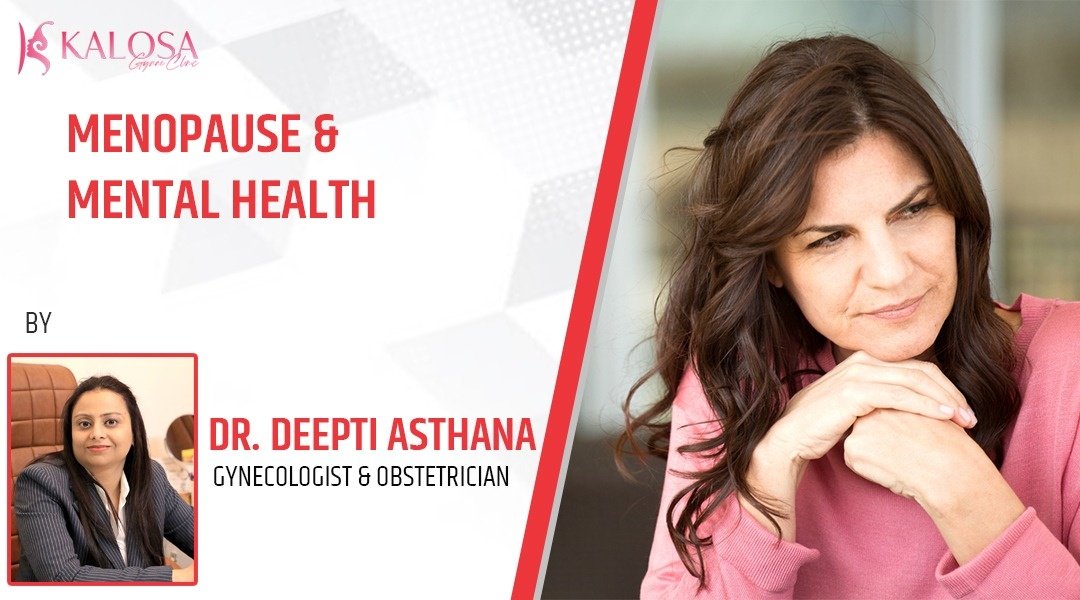
Menopause & Mental Health

Menopause and Mental HealthThe hormonal changes behind the mood changes

Posted by Dr. Deepti Asthana on 20-09-2026

Menopause is when your period stops permanently. Menopause is a natural stage in a woman’s life. You may have menopause symptoms and irregular periods as your body changes to menopause over time.

The average age for menopause is 52. As a result of the hormonal changes that occur during menopause, it is normal for women to develop mental health issues.

Book Your Consultation
Menopause and mental health - Dr Deepti Asthana, best gynecologist in Fortis Gurgaon

What links are there between mental health problems and menopause?

Menopause causes a number of physical symptoms, all of which can be distressing, alongside mood changes that are common during this transition.

Menopause is when your period stops permanently — a natural stage in a woman’s life.

You may have menopause symptoms and irregular periods as your body changes over time.

The average age for menopause is 52.

As a result of the hormonal changes that occur during menopause, it is normal for women to develop mental health issues.

Mental health changes during menopause

Physical symptoms

  • Fatigue.
  • Night sweats.
  • Sleeplessness.
  • Memory loss.
  • Tension.

Mood changes

  • Impatience.
  • Sorrow.
  • Lack of motivation.
  • Aggression.
  • Issues focusing and difficulty concentrating.
  • Tension and depression.

These consequences, like chronic premenstrual syndrome (PMS), can induce emotional stress. If you have a pre-existing mental health issue, the impacts of menopause may induce a relapse or change in your mental health.

Mental health conditions
linked with menopause

01

Depression and menopause

A relationship between depression and menopause has yet to be discovered in clinical investigations. Women who had severe PMS in their younger years or experienced postpartum depression may have more severe mood fluctuations during perimenopause, according to research.

Women who have previously had clinical depression are more likely to have recurrent clinical depression at menopause.

02

Menopause and bipolar disorder

Menopause has been linked to an increase in bipolar illness symptoms. According to research, women with bipolar disorder are more vulnerable to hormonal changes throughout menopause.

Women with bipolar disorder had more depressive episodes throughout menopause than those who do not. This is most likely due to a drop in the hormone oestrogen, which occurs naturally throughout menopause.

03

Schizophrenia and menopause

According to research, a decrease in oestrogen might cause or aggravate mental health disorders, including psychotic illnesses. Women with pre-existing chronic schizophrenia may face worsening symptoms and a greater need for treatment.

Perimenopause may also increase the likelihood of developing schizophrenia psychosis for the first time. While schizophrenia often manifests itself in adolescence, there is a second peak in women around menopause.

04

A pre-existing mental health issue

  • The hormonal changes of menopause can trigger a relapse in a condition that was previously well controlled
  • Existing treatment may need to be reviewed and adjusted during this transition
  • Close communication between your gynaecologist and your mental health provider matters more during this period than at most other times
  • A change in mental health during menopause is common enough that it should always be raised, not dismissed as “just menopause”

Symptoms

Mood disturbances connected with the menopause transition can manifest as a wide range of symptoms. Screening measures such as the Center for Epidemiologic Studies Depression Scale Revised (CESD-R) are frequently used in this environment to identify symptoms, which may include:

  • Low mood.
  • Sleep problems.
  • Lack of appetite.
  • Reduced libido.
  • Feelings of worthlessness.
  • Loss of interest in regular activities.

Depressive symptoms may be severe enough to constitute a depressive disorder. However, some depressive symptoms, such as sleep trouble and reduced libido, are common menopausal experiences that are unrelated to mood disorder. This distinction is clinically significant for providing patient-centered care, guiding management decisions, and tracking therapy response.

Potential causes

There is a lot of evidence that there is a link between the menopause transition and depressive symptoms.

  • Several longitudinal studies have found that women in the menopause transition are up to twice as likely as premenopausal women to develop a depressive disorder, regardless of a history of depression, with an overall frequency of up to 40%.
  • Data about the postmenopausal period is contradictory. Women with no past history of depression who had a perimenopausal depressive disorder had no increased risk of postmenopausal depression compared with women who had no depressive symptoms linked with the menopause transition.
  • There is no strong evidence establishing a link between basal hormone levels and symptom onset. However, multiple evidence strongly suggests that the illness has a hormonal component.
  • There is a large body of evidence from animal and human studies demonstrating the role of ovarian steroids in neuroregulatory pathways, particularly those involving serotonin and noradrenaline, both known to be involved in depression.
  • Randomised controlled data suggests a significant improvement in depressed symptoms with the use of hormonal replacement therapy, as well as the reappearance of depressive symptoms in women with perimenopausal depression following the discontinuation of hormone treatment.
Understanding the causes of menopausal mood changes
Sleep quality and vasomotor symptoms during menopause

Other contributing factors

There are various other factors in the menopause transition that contribute to the development of depressive symptoms.

  • Vasomotor symptoms increased the likelihood of acquiring depressed symptoms, while depressive symptoms increased the prevalence of vasomotor symptoms.
  • Poor sleep quality during the menopause transition has also been linked to the condition.
  • Vasomotor symptoms, through lowering sleep quality, may predispose women to depression.
  • However, the research is inconsistent, and decreased sleep quality occurs throughout this time regardless of vasomotor symptoms.

Management

Depressive symptoms during the menopause transition are multifaceted, and treatment should take into account the individual’s medical history as well as clinical experience.

Antidepressants

Antidepressants continue to be the first-line pharmaceutical treatment for perimenopausal mood disorder.

Oestrogen hormone therapy

Has been demonstrated to be useful in treating perimenopausal women’s depressed symptoms. For women with an intact uterus, concurrent progesterone medication is required, which has been shown to potentially aggravate depression symptoms.

Hormone therapy as an adjunct

While hormone therapy may provide additional benefit for mood disturbance when used to treat vasomotor symptoms, current guidelines advise against using hormonal therapy to treat perimenopausal depression as the primary treatment.

Cognitive-behavioural therapy

CBT has been demonstrated to be beneficial in alleviating both physical and psychological symptoms of menopause, and it is an important alternative or addition to pharmacological treatment.

Psychological management

The use of psychological management to address the biopsychosocial difficulties that arise during the menopause transition should also be considered as part of a comprehensive plan.

An individualised plan

Depressive symptoms during the menopause transition are multifaceted, and treatment should take into account the individual’s medical history as well as clinical experience.

When to seek help

Mild mood changes are a normal part of this transition. The following are reasons to book a consultation sooner rather than later.

  • Low mood, tearfulness or irritability that lasts most of the day, most days, for two weeks or more.
  • Loss of interest in activities you would normally enjoy.
  • Thoughts of worthlessness, hopelessness, or that life is not worth living.
  • A significant change in sleep or appetite that is not explained by hot flushes alone.
  • A history of depression, postpartum depression or severe PMS, which raises the chance of a mood change now.
  • Any worsening of a pre-existing mental health condition during this transition.

Call and book your appointment with Dr. Deepti Asthana, who is the best gynecologist in Fortis Gurgaon, if you have been dealing with menopause and its effects.

Dr Deepti Asthana  ·  Care  ·  Precision

Senior Obstetrician & Gynaecologist in Gurgaon

Additional Director, Obstetrics & Gynaecology, Fortis Memorial Research Institute — and Director, Kalosa Clinic.

Dr. Deepti Asthana is a highly distinguished Obstetrician, Gynecologist, and minimally invasive surgeon with over 14 years of clinical experience. She holds an MBBS from KGMC, Lucknow, and an MS from SMS Medical College, Jaipur. Currently, she serves as a Consultant at Fortis Memorial Research Institute, Gurgaon, and is the esteemed Director of Kalosa Aesthetics.

A highly specialized area of her advanced gynecological practice is understanding how the hormonal transitions of menopause affect a woman’s mental health, and guiding her through it with a treatment plan that considers both mind and body together.

With specialized fellowship training in laparoscopic surgery, Dr. Asthana provides compassionate, world-class care for complete female wellness, from fertility-preserving surgeries to pioneering cosmetic gynecology.

  • 20+ years in women’s health and laparoscopic surgery
  • 30,000+ patients and 10,000+ surgeries

Meet Dr Deepti Asthana

Dr Deepti Asthana, gynaecologist in Gurgaon
Patient Testimonials

What patients are saying
about Dr Deepti Asthana

Recognising that patient care, a gentle bedside manner and precise clinical outcomes come first, Dr Deepti Asthana takes pride in being a compassionate doctor who always puts her patients’ needs first.

SN
Shweta Nikki
★★★★★

I am extremely grateful to my gynaecologist Dr Deepti Asthana for excellent care and guidance throughout my pregnancy and delivery from the very first visit till the birth of my first baby. Thank you for your expertise and dedication. Highly recommended for any expectant parents.

February 15, 2026 | Google
HK
Harshdeep Kaur
★★★★★

I have been consulting Dr. Deepti since the past 3 years. Starting as my gynaecologist, treating my PMOS to guiding me into motherhood and finally, being my Obstetrician to deliver my twin babies via C-section. She has been an unwavering support throughout the journey, and all this could not have been possible without her. She has a very professional, knowledgeable, non-judgmental and empathetic approach towards all her patients, and makes you feel comfortable and heard. I can definitely recommend her to others with my eyes closed.

August 15, 2026 | Google
MB
Manjul Bajaj
★★★★★

Dr Deepti Asthana is a wonderful doctor and I feel really fortunate to have found her. She has a pleasant, positive and reassuring manner. She listened to my concerns as a patient and factored them in her treatment plan. My surgery went off seamlessly and the recovery is also very good. Her coordinator Rhea was also very helpful.

July 17, 2026 | Google
Watch Our Videos

Menopause, explained on video

Dr Deepti Asthana answers the questions patients ask most often in the clinic.

Menopause Symptoms Explained

Dr Deepti Asthana explains the physical and emotional changes of menopause.

Hormone Therapy: Who It Suits

When hormone replacement helps with menopausal symptoms, and when it is avoided.

Bone and Mental Health After 45

Protecting your physical and emotional wellbeing through the menopause transition.

Quick Health Insights

From our Instagram

Short expert insights on menopause, mental health and women’s wellbeing.

Frequently asked questions

As a result of the hormonal changes that occur during menopause, particularly the drop in oestrogen, it is normal for women to develop mental health issues. Oestrogen plays a role in neuroregulatory pathways involving serotonin and noradrenaline, both of which are involved in mood regulation.

Mood changes such as impatience, sorrow, lack of motivation, aggression, issues focusing, tension, difficulty concentrating and depression are prevalent throughout menopause. These effects, like chronic premenstrual syndrome, can induce emotional stress.

A direct causal relationship has yet to be established in clinical investigations, but several longitudinal studies have found that women in the menopause transition are up to twice as likely as premenopausal women to develop a depressive disorder, with an overall frequency of up to 40%.

Yes. If you have a pre-existing mental health issue, the impacts of menopause may induce a relapse or a change in your mental health. Women with bipolar disorder or chronic schizophrenia may see symptoms worsen and need closer review of their treatment during this period.

Perimenopause may increase the likelihood of developing schizophrenia psychosis for the first time. While schizophrenia often manifests in adolescence, research shows there is a second peak in women around menopause.

Screening measures such as the Center for Epidemiologic Studies Depression Scale Revised (CESD-R) are frequently used. Symptoms may include low mood, sleep problems, lack of appetite, reduced libido, feelings of worthlessness, and loss of interest in regular activities.

No. Some symptoms, such as sleep trouble and reduced libido, are common menopausal experiences unrelated to a mood disorder. This distinction matters clinically, since it guides management decisions and helps track how well treatment is working.

Oestrogen hormone therapy has been shown to help perimenopausal depressive symptoms in some studies. However, current guidelines advise against using hormonal therapy as the primary treatment for perimenopausal depression, though it may add benefit when used to treat vasomotor symptoms like hot flushes.

Antidepressants remain the first-line pharmaceutical treatment for perimenopausal mood disorder. Cognitive-behavioural therapy has also been shown to help with both the physical and psychological symptoms of menopause, and treatment is always tailored to individual history.

See a doctor if low mood, irritability or loss of interest in activities lasts most days for two weeks or more, if you have thoughts of worthlessness or hopelessness, or if an existing mental health condition seems to be worsening. Early assessment allows treatment to start sooner.

Quick Links